



Root Cause Analysis Course
Root cause analysis is the difference between fixing symptoms and solving causes.
Learn to find, prove and eliminate root causes. You get a structured method and the tools that deliver lasting results.
Format: 3 online sessions (3 x 2 hrs) + SPC online course (1.5 hrs).
Next course: February 18, March 4 & 18.
Interested in the online course? Join the waitlist.
Who is this for?
This course is for you if you:
- Keep encountering the same problems and want to solve them once and for all.
- Work with quality deviations, technical failures or complaints and need a structured method for finding root causes.
- Need to review or approve others' root cause analyses and want to know what separates a good analysis from a poor one.
- Use 5 Whys today, but know it doesn't always get you to the real root cause.
- Want to choose the right method for the right problem: when to use 5 Whys, Fishbone, Process Mapping, Fault Tree Analysis or Apollo.
This course suits anyone experiencing recurring problems that aren't being solved effectively, regardless of industry or role.

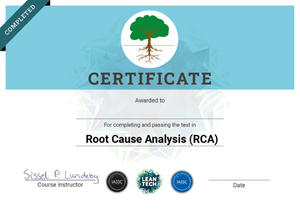
Includes course certificate
What you learn in RCA Course:
- A structured method for finding and proving root causes based on data and facts — not gut feeling and quick conclusions.
- Choose the right tool for the right problem. When does 5 Whys, Fishbone, Process Mapping, Fault Tree Analysis or Apollo work best?
- Distinguish between special cause events and systemic problems, and choose the right strategy for each.
- Prove root causes using observation, data, graphical analysis and statistics, so your actions target what's actually driving the problem.
- Follow up and ensure the solution holds over time.
Course certificate upon completing the online sessions. Separate course certificate for the SPC online course upon passing the test.
What do participants say?
«The content was presented in a very organised, easy to follow and engaging way. Great interaction between participants and the instructor. Works well both as a refresher or a starting point.»
Mara da Silva, Benteler Raufoss
«Excellent effort and good examples that were easy to understand.»
Course participant
«Great learning outcome. It's important that a team has a shared understanding and a common approach.»
Course participant


How the course works
- Session 1 (2 hrs): Introduction to systematic problem solving — from understanding and describing the problem, to implementing actions and ensuring lasting results.
- SPC online course (1.5 hrs): Before you ask «why», ask «how often». You learn to distinguish normal from special cause variation — essential for choosing the right method. Read more.
- Session 2 (2 hrs): Finding possible causes. The method depends on the type of problem. You learn when to use 5 Whys, Fishbone, Process Mapping, Apollo and Fault Tree Analysis.
- Session 3 (2 hrs): Proving root causes using graphical analysis — histogram, Pareto, run chart, box plot and scatter plot.
Recording: All sessions are recorded — if you can't join live, you can watch the recording afterwards.
Session 1: Introduction to systematic problem solving
- Prioritise the problem and determine focus.
- Map the current situation.
- Set specific goals.
- Understand possible causes and prove the most important ones.
- Generate possible solutions and evaluate them.
- Implement actions.
- Ensure lasting results.
SPC online course (completed between sessions)
- Module 1: Understanding variation — process mapping and types of variation.
- Module 2: Control charts — creating and interpreting control charts, understanding probability and responding correctly.
- Module 3: Capability — process capability and choosing the right problem-solving strategy.
- SPC quiz and course certificate upon passing the test.
- Bonus: Real-world examples showing SPC in practice.
Session 2: Finding possible causes
- Use SPC to understand the type of problem and choose the right method.
- 5 Whys and Fishbone: for rare events with a single clear cause.
- Process mapping: for complex systemic problems with many variables.
- Apollo root cause analysis: for health and safety incidents where people are involved.
- Fault Tree Analysis (FTA): technical and logical approach using AND/OR logic.
Session 3: Proving root causes
- Observation and the turn on/off method.
- Histogram and Pareto — understand distribution and prioritise effort.
- Run chart and control chart — reveal patterns over time.
- Box plot — compare datasets grouped by possible causes.
- Scatter plot and correlation — reveal relationships between variables.
What happens if I can't attend a session?
All sessions are recorded. If you can't join live, you will have access to the recording afterwards and can watch it when it suits you.
Do I need any prior knowledge?
No. The course builds from the ground up, step by step. It is an advantage to have a real problem to work on, but it is not a requirement.
How much time do I need to set aside?
The sessions are scheduled (3 x 2 hrs) and the SPC online course takes 1.5 hours. All sessions are recorded, so you can watch the recording if you can't join live.
What is included in the price?
Three online sessions, access to the SPC online course, course documentation and templates. Course certificate upon completing the sessions and a separate course certificate for the SPC online course upon passing the test.
What types of problems is this course for?
This course suits anyone dealing with recurring problems that aren't being resolved effectively. Recurring problems are a symptom that root causes haven't been found and eliminated. The course covers both simple, isolated incidents and complex systemic problems — and teaches you to tell them apart. It applies to quality deviations, technical failures, health and safety incidents and process problems, across all industries.
What is the difference between this course and Yellow Belt?
Root Cause Analysis is a dedicated course in methods and tools for finding and proving causes. It covers more methods than Yellow Belt — including Apollo, Fault Tree Analysis and graphical analyses such as histogram, Pareto, run chart, box plot and scatter plot. If you have a specific problem you want support solving, Yellow Belt is the better fit. If you want to build your methodological toolkit, Root Cause Analysis is the right place to start.
I've used 5 Whys before, but it doesn't always seem to work. Why?
5 Whys is a good tool for simple, isolated incidents with a single cause. When you apply it to complex systemic problems — where the issue occurs frequently and seemingly at random — you tend to find a scapegoat rather than the root cause. This course teaches you to select the right tool based on the type of problem.
I've tried structured problem solving before. Why will this be any different?
Because most people stop too soon. The problem is described too vaguely, symptoms get mistaken for root causes, and actions are put in place before the cause has been proven. This course gives you the method and tools to go all the way — not just far enough to feel like something has been done.
Is this relevant to my industry?
The method is industry-neutral. It is about processes, not products. Our participants come from oil and gas, manufacturing, food industry, healthcare and the public sector.
Can I use this even if I'm not a manager?
Yes. You don't need a management role to work systematically with problem solving. What you need is access to a problem worth solving and colleagues who are willing to look at it with you.
Instructor
«Before you ask why, ask how often. Rare failures have one root — recurring failures have a root system. Choosing the right method based on the type of problem is the first step towards a lasting solution.»
Sissel P. Lundeby, 20+ years of experience in process improvement • IASSC accredited instructor • MSc Chemical Engineering • Black Belt since 2002

Solve root causes once — not the same problem again and again.
Next course: February 18, March 4 & 18.
Price: NOK 8,450 excl. VAT
Interested in the online course? Join the waitlist.
Assignments
Contact info
Lean Tech AS | Kristoffer Robins vei 13
0047 481 23 070
Oslo, Norway
Lean
L - Look for solutions
E – Enthusiastic
A – Analytical
N - Never give up