For those who want to solve problems at the root
For those who want to solve problems at the root
Not just fight fires
Not just fight fires
Does the same problem keep coming back, no matter what you do?
Format: Online course (~4 hours) | Learn at your own pace.
Learn to find, prove and eliminate root causes, not just suppress symptoms. You get a structured method that delivers lasting results.
This course is for you if you:
This course suits anyone experiencing recurring problems that aren't being solved effectively, regardless of industry or role.
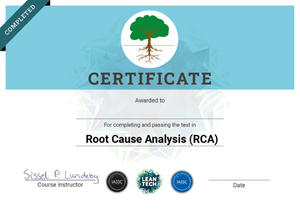
Course certificate upon passing the final test (online course). In-house courses include a course certificate upon completion.
«The content was presented in a very organised, easy to follow and engaging way. Great interaction between participants and the instructor. Works well both as a refresher or a starting point.»
Mara da Silva, Benteler Raufoss
«Excellent effort and good examples that were easy to understand.»
Course participant
«Great learning outcome. It's important that a team has a shared understanding and a common approach.»
Course participant
Online course (coming soon): Work through the content at your own pace, module by module. The course covers everything from understanding the problem and root cause analysis to proving causes and following up. Course certificate upon passing the test.
Online course with individual coaching (coming soon): Same online course, with individual coaching sessions where you get help applying the methods to a real problem from your own organisation.
In-house course: We tailor content and format to your needs and challenges. Can be delivered as two days on-site or three virtual sessions. Ideal when a team wants to build shared competence and a common way of working.
Module 1: Why do we keep firefighting?
Our biology, history and organisational culture — and what it takes to break the pattern.
Module 2: A shared understanding of terms
Distinguishing between symptom, problem and root cause — and why a common focus is essential.
Module 3: Assess the current situation and choose a strategy
We use Statistical Process Control (SPC) to understand variation and choose the right strategy. Two types of problems require different tools:
Module 4: Identify possible causes
Module 5: Prove the root causes
Identifying possible causes is one step. Proving them is another. We cover:
Module 6: Select and implement solutions
Good solutions target the proven root causes, not the symptoms. We cover how to generate alternatives, prioritise using a decision matrix and build an action plan with clear ownership and deadlines.
Module 7: Follow up and ensure lasting results
Are we seeing the improvement we expected? Are results holding over time? We use SPC to validate the effect of actions, monitor the process going forward and respond correctly — without overreacting to normal variation.
Test: Multiple choice questions. Unlimited attempts.
Included:
Courses can be arranged on request and customized to your business needs.
Your own data can be used in examples and exercises.
Open courses are arranged according to the Course Calendar.
You can start e-learning when you want. You have access for a year and unlimited attempts to successfully complete multiple-choice exam.
Lunch, refreshments, and drinks during classroom training are included, and you receive a course completion certificate.
Course location varies; check "Place" in Course Calendar.
Lean Tech is located at Kristoffer Robins vei 13 (0978 Oslo) and organizes courses here.
We have an agreement with Thon Hotels and organize courses in other locations as needed.

Sissel Pedersen Lundeby is IASSC (International association for Six Sigma certification) accredited trainer associate:
"This accreditation publically reflects that you have met the standards established by IASSC such that those who participate in a training program led by you can expect to receive an acceptable level of knowledge..."
Sissel has a Master in Chemical Engineering and more than 20 years' experience within manufacturing and environmental technology. She has practiced Lean Six Sigma since 2002, completing Black Belt projects and certification through Cytec (2004) and IASSC (2017).
She use Lean Six Sigma to create measurable results and want her course participants to be successful improving their processes. That's why her training focus on practical application.
"Inspiring, professionally competent, popularize a theoretical discipline"
Espen Fjeld, Commercial Director at Berendsen
"Academic highly skilled and clear performance. Fun and builds trust"
Jon Sørensen, Production Manager at Berendsen
"10/10 good at reaching everyone"
Erlend Stene, Sales leader at Berendsen
"Clear and well presented. Good at asking questions and listen (check understanding)"
Morten Bodding, Production Manager at Berendsen
"Made a difference, engaged and skilled"
- Participant from EWOS
"You are inspiring, positive and professionally skilled"
- Participant from EWOS
"Clear presentations and well explained"
"I thought it was very rich, with good examples that made me reflect"
Do I need any prior knowledge?
No. The course builds from the ground up, step by step. You don't need any background in Lean or Six Sigma. The course includes exercises that help you apply the tools as you go — it's an advantage to have a real problem to work on, but it's not a requirement.
How much time do I need to set aside?
The course content is around 4 hours, but the goal isn't to sit through 4 hours of theory. You learn best by using the tools as you go — the course includes exercises that help you apply what you learn. You set your own pace and have access to the course for 1 year.
What is included in the price?
Access to all course modules for 1 year, course documentation, root cause analysis templates and a course certificate upon passing the test. Access applies to one person.
What types of problems is this course for?
This course suits anyone dealing with recurring problems that aren't being resolved effectively. Recurring problems are a symptom that root causes haven't been found and eliminated. The course covers both simple, isolated incidents and complex systemic problems — and teaches you to tell them apart. It applies to quality deviations, technical failures, health and safety incidents and process problems, across all industries.
What is the difference between this course and Yellow Belt?
Root Cause Analysis is a dedicated course in methods and tools for finding and proving causes. It covers more methods than Yellow Belt — including Apollo, Fault Tree Analysis and graphical analyses such as histogram, Pareto, run chart, box plot and scatter plot.
Yellow Belt covers systematic problem solving and includes personal coaching while you work on a real problem in your own organisation, leading to certification. If you have a specific problem you want support solving, Yellow Belt is the better fit. If you want to build your methodological toolkit, Root Cause Analysis is the right place to start.
I've used 5 Whys before, but it doesn't always seem to work. Why?
5 Whys is a good tool for simple, isolated incidents with a single cause. When you apply it to complex systemic problems — where the issue occurs frequently and seemingly at random — you tend to find a scapegoat rather than the root cause. This course teaches you to select the right tool based on the type of problem.
I've tried structured problem solving before. Why will this be any different?
Because most people stop too soon. The problem is described too vaguely, symptoms get mistaken for root causes, and actions are put in place before the cause has been proven. This course gives you the method and tools to go all the way — not just far enough to feel like something has been done.
Is this relevant to my industry?
The method is industry-neutral. It's about processes, not products. Our participants come from oil and gas, manufacturing, food industry, healthcare and the public sector.
Can I use this even if I'm not a manager?
Yes. You don't need a management role to work systematically with problem solving. What you need is access to a problem worth solving and colleagues who are willing to look at it with you.
I was very impressed with Sissel's Lean Six Sigma knowledge. She makes it easy to identify improvements and create results.
Lean Tech AS | Kristoffer Robins vei 13
0047 481 23 070
Oslo, Norway
L - Look for solutions
E – Enthusiastic
A – Analytical
N - Never give up