






SPC training
Very engaged and focused throughout the course. Sticking to the agenda. Nice and pleasant.
Vegard Løkken
Production Manager, Nammo
Have you made improvements but are unsure whether the results are real — or just random variation?
Format: Online course (~1 hour) | Learn at your own pace.
Learn to develop and test hypotheses, separate real differences from noise and prove cause-and-effect relationships using statistics.
This course is for you if you:
This course suits anyone working with data and improvement, regardless of industry or role.
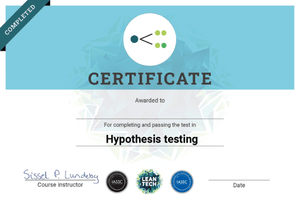
Course certificate upon passing the final test.
Online course (coming soon): Work through the content at your own pace, module by module. Course certificate upon passing the test.
Online course with individual coaching (coming soon): Same online course, with individual coaching sessions where you get help applying the methods to your own data and problems.
In-house training: We tailor content and format to your needs. Can be delivered as virtual or in-person sessions.
Module 1: Basic statistics and probability
Statistics and probability as the foundation for hypothesis testing.
Module 2: Developing hypotheses
Develop null and alternative hypotheses based on theories about cause-and-effect relationships.
Module 3: Practical and statistical significance
Understand the difference between what is statistically significant and what actually matters in practice.
Module 4: Selecting the right test
Determine which statistical test to use based on data type (continuous and discrete) and the problem at hand.
Module 5: Testing center and variation
Determine whether datasets have significantly different center or variation. Type I and Type II errors.
Module 6: Sampling strategy and sample size
Assess your sampling approach and how many measurements you need for reliable conclusions.
Module 7: Correlation and regression
Uncover and quantify relationships between variables.
Test: Multiple choice questions. Unlimited attempts.
Included:
Courses can be arranged on request and customized to your business needs.
Your own data can be used in examples and exercises.
Open courses are arranged according to the Course Calendar.
You can start e-learning when you want. You have access for a year and unlimited attempts to successfully complete multiple-choice exam.
Lunch, refreshments, and drinks during classroom training are included, and you receive a course completion certificate.
Course location varies; check "Place" in Course Calendar.
Lean Tech is located at Kristoffer Robins vei 13 (0978 Oslo) and organizes courses here.
We have an agreement with Thon Hotels and organize courses in other locations as needed.

Sissel Pedersen Lundeby is IASSC (International association for Six Sigma certification) accredited trainer associate:
"This accreditation publically reflects that you have met the standards established by IASSC such that those who participate in a training program led by you can expect to receive an acceptable level of knowledge..."
Sissel has a Master in Chemical Engineering and more than 20 years' experience within manufacturing and environmental technology. She has practiced Lean Six Sigma since 2002, completing Black Belt projects and certification through Cytec (2004) and IASSC (2017).
She use Lean Six Sigma to create measurable results and want her course participants to be successful improving their processes. That's why her training focus on practical application.
"Inspiring, professionally competent, popularize a theoretical discipline"
Espen Fjeld, Commercial Director at Berendsen
"Academic highly skilled and clear performance. Fun and builds trust"
Jon Sørensen, Production Manager at Berendsen
"10/10 good at reaching everyone"
Erlend Stene, Sales leader at Berendsen
"Clear and well presented. Good at asking questions and listen (check understanding)"
Morten Bodding, Production Manager at Berendsen
"Made a difference, engaged and skilled"
- Participant from EWOS
"You are inspiring, positive and professionally skilled"
- Participant from EWOS
"Clear presentations and well explained"
"I thought it was very rich, with good examples that made me reflect"
Do I need prior knowledge of statistics?
It is an advantage to have a basic understanding of statistics and SPC, but it is not a requirement. The course builds understanding step by step.
What is included in the price?
Access to all course modules for 1 year, course documentation and course certificate upon passing the test. Access applies to one person.
How much time do I need to set aside?
The course is approximately 1 hour. You set your own pace and can pause and continue when it suits you. Access lasts for 1 year.
Which tool is used in the course?
We use Excel in the course and show which tests are available in statistical tools such as Minitab, JMP and SigmaXL.
What is the connection between this course and Root Cause Analysis?
Root Cause Analysis covers graphical tools such as histogram, Pareto, run chart, control chart, box plot and scatter plot to prove causes. Hypothesis Testing goes deeper into the statistical side — you learn to test whether differences are statistically significant and to quantify relationships using correlation and regression. The two courses complement each other well.
Is this relevant to my industry?
Yes. Hypothesis testing is industry-neutral and applies wherever you have data and want to make fact-based decisions.
Very engaged and focused throughout the course. Sticking to the agenda. Nice and pleasant.
Lean Tech AS | Kristoffer Robins vei 13
0047 481 23 070
Oslo, Norway
L - Look for solutions
E – Enthusiastic
A – Analytical
N - Never give up


